
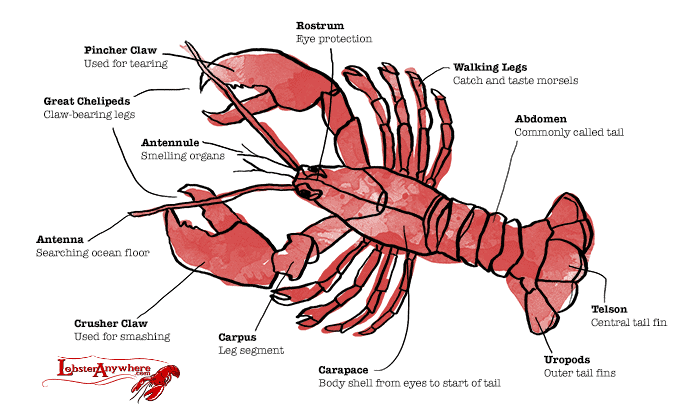
Crack open a lobster and you’re looking at parts most people can’t name. Here’s all of them, inside and out, plus the trade terms you’ll hear at a lobster pound.
The External Anatomy of a Lobster

The lobster’s body is composed of twenty-one segments. Seven segments comprise the abdomen (commonly known as the tail), six comprise the head region, and the remaining eight comprise the thorax. Lobsters belong to the order of decapods (meaning ten feet). They have ten legs, and two legs near the head region have claws at the end. Other important parts include:
Antennae: Lobsters carry two sets. The long pair sweeps the water ahead of them and works by touch, mapping obstacles, predators, and prey in the dark. The shorter paired antennules underneath are the chemical sensors, covered in hundreds of tiny hairs that read the water the way a nose reads air. A lobster has no nose, but it smells with those hairs, and it does it well enough to track food across a considerable distance.
Eyes: Lobsters have compound eyes mounted on movable stalks, set just beneath the antennae. Each eye is built from thousands of tiny lens units. They’re very sensitive to light and good at picking up shadows and movement, but they don’t resolve images or distinguish color.
Shell: A lobster wears its skeleton on the outside. The exoskeleton is armor, and it can’t grow, so the lobster has to shed it and build a bigger one, a process called molting. It happens about 25 times before a lobster reaches legal size, and the animal is soft and defenseless for a while afterward. That’s the difference between a hard-shell and a soft-shell, and it’s the single biggest factor in how much meat you get. Here’s why it matters when buying a hard-shell lobster.

Carapace: The hard shell over the head and body, minus claws, knuckles, and tail. It houses the legs, the tomalley, and in females the roe. Maine measures legal size by carapace length: anything under 3 1/4 inches or over 5 inches goes back in the water.
Legs: Ten in total, which is what makes a lobster a decapod. The front pair are the claws. The remaining four pairs are the walking legs, and each one holds a thin strip of sweet meat that takes patience to get at. Serious lobster eaters don’t skip them. Here’s how to work through a whole lobster without missing anything.
The count trips people up constantly. Plenty of clip art and restaurant signage gets it wrong, and so did Apple: the original lobster emoji shipped with eight legs instead of ten, which took a complaint from the State Maine to get fixed.
Pleopods: The small feathery appendages under the tail, better known as swimmerets. You’ll see them when the lobster is on its back. They fan water over the gills, help with slow forward movement, and, in females, they’re where the eggs ride until they hatch.
Claws: Lobsters use their claws to catch food, break it apart, and fight off predators and other lobsters. The two don’t match. The larger crusher claw has broad, rounded, molar-like teeth for cracking shells. The smaller cutter claw, also called the pincer or ripper, has sharp serrated edges for tearing food into pieces. Which side each one lands on varies, so you’ll see right-crushers and left-crushers. Both are technically chelipeds. On a hard-shell lobster, the claws are packed with sweet, tender meat, and males generally carry heavier claws than females.
A lobster can also throw a claw on purpose. It’s called autotomy, a reflex amputation at a built-in breaking point, and it lets the animal escape a predator or a fight. The limb grows back over successive molts, which can take anywhere from several months to a few years depending on the lobster’s size. Legs and antennae regenerate the same way.
Knuckles: The two joints connect the large claws to the carapace. Connoisseurs say the knuckle meat is the tastiest.
Tail: The tail is the escape mechanism. A hard contraction shoots the lobster backward through the water, fast, which is why a lobster you startle in a tank vanishes in the wrong direction. The fan at the end is made of a central fin called the telson flanked by smaller ones called uropods, and together they steer and stabilize the flip. Females have larger tails than males, and the tail carries more meat than any other part of the lobster.
The Internal Anatomy of a Lobster

Digestive System: Three parts, foregut to midgut to hindgut. The mandibles tear food apart, the pieces get swallowed mostly whole, and the gastric mill grinds them down. The midgut absorbs nutrients with help from the hepatopancreas, the digestive gland better known as tomalley. Waste exits through the intestinal vein running down the underside of the tail. Lobsters aren’t picky: fish, crabs, clams, mussels, sea urchins, worms, some marine plants, and whatever’s already dead when the chance comes up.
Circulatory System: Lobsters have an open circulatory system. A single-chambered heart sits above the stomach and pushes blood out through a branching artery network, but the blood is not sealed inside vessels the way ours is. It empties into sinuses and cavities, bathes the organs directly, then drains back toward the gills and the heart. Lobster blood is clear until it meets oxygen, when copper-based hemocyanin turns it faintly blue. More on lobster blood.
Nervous System: There’s no brain in the vertebrate sense. A supraesophageal ganglion behind the eyes handles the front of the animal, and a chain of nerve clusters called ganglia runs the length of the body, each one managing its own segment. It’s a distributed system rather than a central one, which is why parts of a split lobster can keep moving on local reflex alone. That decentralized wiring is also the heart of the debate over whether lobsters feel pain.
Respiratory System: Lobsters pull oxygen out of seawater through five pairs of feathery, blood-filled gills tucked under the carapace at the base of the legs and claws. Water flows across them, oxygen crosses into the blood, and the swimmerets help keep that water moving. The gills only work wet, which is the whole reason a lobster can travel.
- Can lobsters breathe out of water? For 24 to 36 hours, as long as the gills stay damp. That’s why our live lobsters ship in coolers packed with seawater-dampened paper over gel ice.
- Can lobsters breathe air? No. They’re extracting oxygen from the moisture on their gills, not from the air itself.
Reproductive System: Males have testes and transfer sperm with appendages called gonopods. Females have ovaries and carry fertilized eggs on their swimmerets for close to a year.
Lobster Sizing Names
Size is a rough proxy for age. It takes about 25 molts over 5 to 7 years for a lobster to reach the 1-pound legal minimum, and the big ones are decades old. More on how old a lobster gets.
- Shorts or Snappers: Under the legal minimum, 3 1/4 inches carapace length. These go back in the water.
- Canners: Roughly 1/2 to 1 pound. Named for the 19th-century canneries that packed lobster this size by the case, back when lobster was cheap food rather than a delicacy. We don’t ship them.
- Chickens: About 1 pound, the smallest legal size.
- Quarters: 1 1/4 pounds, the most popular size we ship.
- Halves: 1 1/2 to 1 3/4 pounds.
- Deuces: About 2 pounds.
- Selects: 2 to 2 1/2 pounds.
- Jumbos: Over 3 pounds, up to the 5-inch legal maximum.
- Culls: A lobster missing one or both claws, sold at a lower price. Lobsters drop claws in fights, in traps, and sometimes in transit, and the claw grows back over time. A cull is just as fresh and just as safe to eat as any other lobster, and at the pound it’s usually the best value on the table.
- Market: Not a size so much as a bracket, covering anything from 1 to 3 pounds that’s legal to sell.
What’s Not a Lobster
Two things get sold as lobster that aren’t. Crayfish live in fresh water and top out at a few inches. A langostino is not a Maine lobster either, and if a menu says “lobster” at a price that seems impossible, that’s usually what you’re being sold. For the full family tree, here are the different types of lobster.
What Is the Best Part of the Lobster to Eat?
The claws or the tail is the argument that never ends. The tail carries the most meat, the claws are more tender, and the knuckles quietly beat both. Legs and body meat are worth the work too.
The Stuff Inside Your Lobster
Split a lobster open and you’ll find roe, tomalley, hemolymph, and the intestinal tract. Quick answers below. For what to pull, what to leave, and how to tell undercooked roe from a problem, see what’s inside a lobster tail.
What is the red stuff inside a lobster?
Roe, also called coral. These are the eggs of a female, found at the base of the body and along the tail. Raw, it’s nearly black and gelatinous. Cooked through, it firms up and turns bright coral red, which makes it a handy doneness check. It’s edible, and it was once treated like caviar.
A fertile female produces roughly 10,000 eggs, each about the size of a pinhead, held together by a natural glue. She carries them under her tail for close to a year. Only about one percent of the larvae make it to adulthood. Lobstermen return egg-bearing females to the water and notch the tail so she stays protected on future hauls.
What color is the blood of a Lobster?
Clear, not red. Lobsters carry oxygen using hemocyanin, a copper-based protein, instead of the iron-based hemoglobin we use. Raw, the blood looks like transparent egg white, and most of it sits in and around the claws. When it meets oxygen, through injury or cooking, it shifts to a faint blue. That’s why you sometimes see a bluish tinge on a cull. Here’s the full story on lobster blood color.
What is the green stuff inside a lobster?
That’s the tomalley, the lobster’s hepatopancreas, a single organ doing the work of both a liver and a pancreas. You’ll find it in the body cavity, soft and green once cooked.
Some people love it and spread it on toast. We’d skip it. Because the organ works as a filter, contaminants concentrate there, and during red tide events it can carry toxins that cooking doesn’t break down. Maine health officials advise against eating it. The advisory covers the tomalley only. Tail and claw meat test clean.
If you’d rather not see it, scoop it out after cooking and splitting.
What’s that white gelatinous stuff after cooking?
Cooked lobster blood. The clear hemolymph proteins congeal under heat and set into a white, chalky gel, which is why it shows up both inside the lobster and in the pot water. It’s tasteless, odorless, and safe to eat. Some cooks stir it into a sauce or bisque, where it thickens things slightly and adds body.
Seeing a lot of it is normal on a freshly cooked hard-shell lobster. It isn’t a sign anything’s wrong.
Does a lobster have a brain?
Not the way a vertebrate does. It runs on the distributed nervous system described above.
Split the head open, and you’ll find a piece of New England folklore waiting. The structure inside is said to resemble the Virgin Mary with two angels praying at her sides, and it holds up from just about any angle you look at it.
I thought lobsters were red?
Lobsters come in almost every color except red. Live, they run dark blue-green through greenish-brown to nearly black, with the shade varying lobster to lobster. Now and then a boat lands an orange, yellow, or blue one, and blue runs about one in 2 million. Shell pigments cause the color, and cooking destroys all of them except astaxanthin, the stable red pigment underneath. That’s the only reason a cooked lobster looks the way it does. More on what color lobsters really are, including the odds on rare ones.
Do lobsters have teeth?
Yes, and they’re in the stomach. A lobster tears food apart outside with its mandibles, then swallows the pieces largely unchewed. The grinding happens in the gastric mill, a set of calcified plates that mash everything down before digestion.
Not sure what size to order? Our size guide breaks down how many people each weight feeds. Or skip ahead and shop live lobster.
What part of the lobster can’t you eat?
No part of a lobster is poisonous. You can eat nearly all of it, shell included, ground up the way French bisque uses it to thicken and flavor the soup. Three things are worth pulling out anyway:
- Intestinal vein: The dark bluish-gray line running from the body through the underside of the tail. Safe, but bitter. Take it out.
- Head sac: Behind the eyes, sometimes called the grain sac or sand sac. It can hold shell fragments, sand, or bait. Split the head lengthwise with a sharp knife and pull it.
- Tomalley: Skip it, for the red tide reasons covered above.
The vein and the sac won’t hurt you. Removing them just makes for better eating.
Know the parts and the whole thing gets easier, whether you’re picking the knuckles clean or explaining to someone at the table what the green stuff is. Browse more lobster guides for recipes, cooking times, and buying tips.
Order fresh Maine lobster to your door with overnight shipping, free in the US.
Since this is lobster lingo, the correct terminology is tomalley (from the Carib word tumale, meaning a sauce of lobster liver), not tamale, (from the Spanish word tamal, plural tamales, in Mesoamerican cuisine, a small steamed cake of dough made from corn).
Thanks for spotting the typo and the etymology information. While some lobster lovers love the tomally, I would rather have a chicken tamale!
This was fascinating information, thank you! And I enjoyed the humor. I bear no ill will to anyone who farms, fishes or eats lobster, but this all confirms that I could never eat one, although I’m sure they’re delicious. (For 40 years I was veg, then sadly, for health reasons, began to eat birds and fish.) Lobsters are just to amazing to eat. And remember the one that became a news story a few decades back? 150 years old and walked the ocean floor to the US East Coast from Asia! Incredible accomplishment! More than I’ve ever done. Couldn’t eat ’em.
If you have time for a Q, can a lobster survive in the wild if it has lost both its claws? Can it even eat, if has only one? Seems like killing and eating would be a two-claw job. Anyway, thanks so much for the history and anatomy lesson!
Their claws grow back 🙂
True, although it takes about 5 years for the new claw to get to the size of the one they previously had.
As far as the original question, they are still technically able to eat somewhat using their pincers. The biggest risk to being clawless would be predators and other lobsters, but yes some do live without them.