
Learn everything you need to know about the king of the sea with our Lobster 101 Guide. Our introduction to lobster begins with a quick review of the history of lobster in Maine, types of lobsters, grades of lobster, times of the year it is caught, lobster colors, and, of course, lobster cooking. Plus, we list our favorite fun facts about lobsters.

A Brief History of Lobster in Maine
Lobsters have been harvested commercially since the mid 1800’s. Before this time, it is clear that lobsters were plentiful and bigger in size and lived much longer than they do today. Magellan’s journals note that these “creatures” were as thick as “molasses” in some parts of the coastal waters explored in the old Massachusetts territory, now known as Maine.
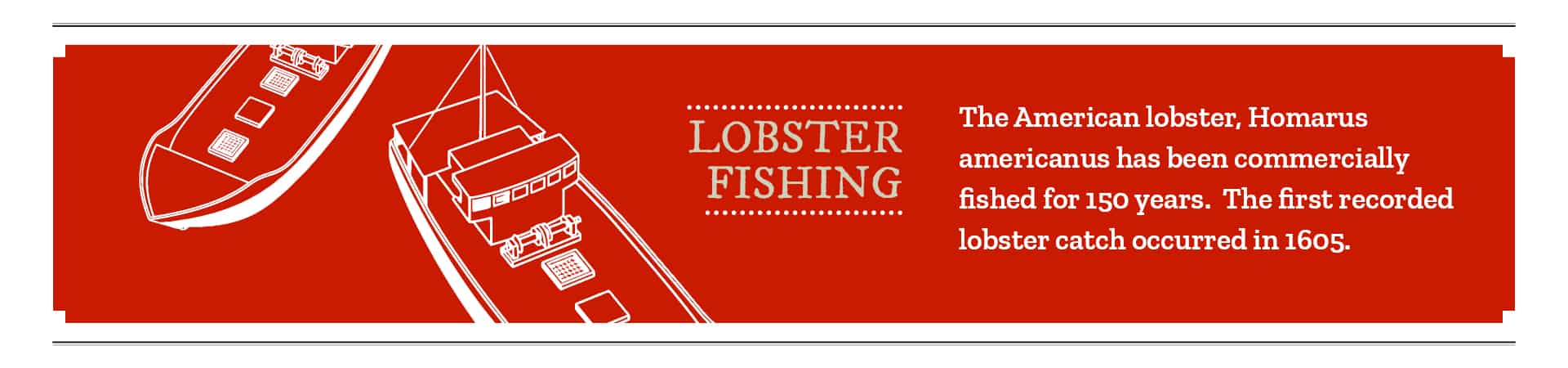
The fishing industry in Maine is second only to timber (per capita). Whereas most pulp and paper activity is controlled by large corporations, the lobster industry is primarily still family-run. This heritage and way of life are passed down from generation to generation to this day. Although a few new technological additions have been added to the mix, little has changed in this culture since lobsters were first commercially harvested in the mid 1800’s
[convertful id=”21336″]
It was the New Yorkers and Bostonians who really gave the Maine lobster its place on the culinary map, after they developed a taste for its deliciously sweet and succulent meat. Lobsters nowadays are somewhat synonymous with exclusive restaurants and expensive buffets. We imagine them nestled amongst leafy green salads, drizzled with butter sauces, displayed on pure white porcelain, and handled with gold cutlery. Lobster has been prized as a delicacy throughout history, especially in Western Europe, with a history stretching from Roman banquet halls to feasts thrown by Tudor monarchs. But lobster is too delicious to leave solely to these precious reserves.
Maine lobster, also known as the American Lobster, is found in the waters between Eastern Canada and North Carolina, with Maine contributing to more than half of all lobsters caught in the United States.
What are the Different Types of Lobsters?
For the most part, there are two main types of lobster: cold water and warm water. First up is the warm-water lobster, which is commonly caught off the coasts of Asia, the Caribbean, Florida, California, and the Mediterranean. Warm-water lobsters have a fishier taste and a softer, mushier texture, which makes them difficult to handle. Cold water lobster is commonly caught off the coast of New Zealand, South Africa, Australia, and, of course, Maine. These lobsters are firmer, sweeter, and more succulent, with whiter meat. They are transported frozen to many warm-water areas because you just can’t compete with their taste. Don’t compromise – always pick cold water Maine lobster. You’ll never be disappointed.
What is a Maine Lobster?
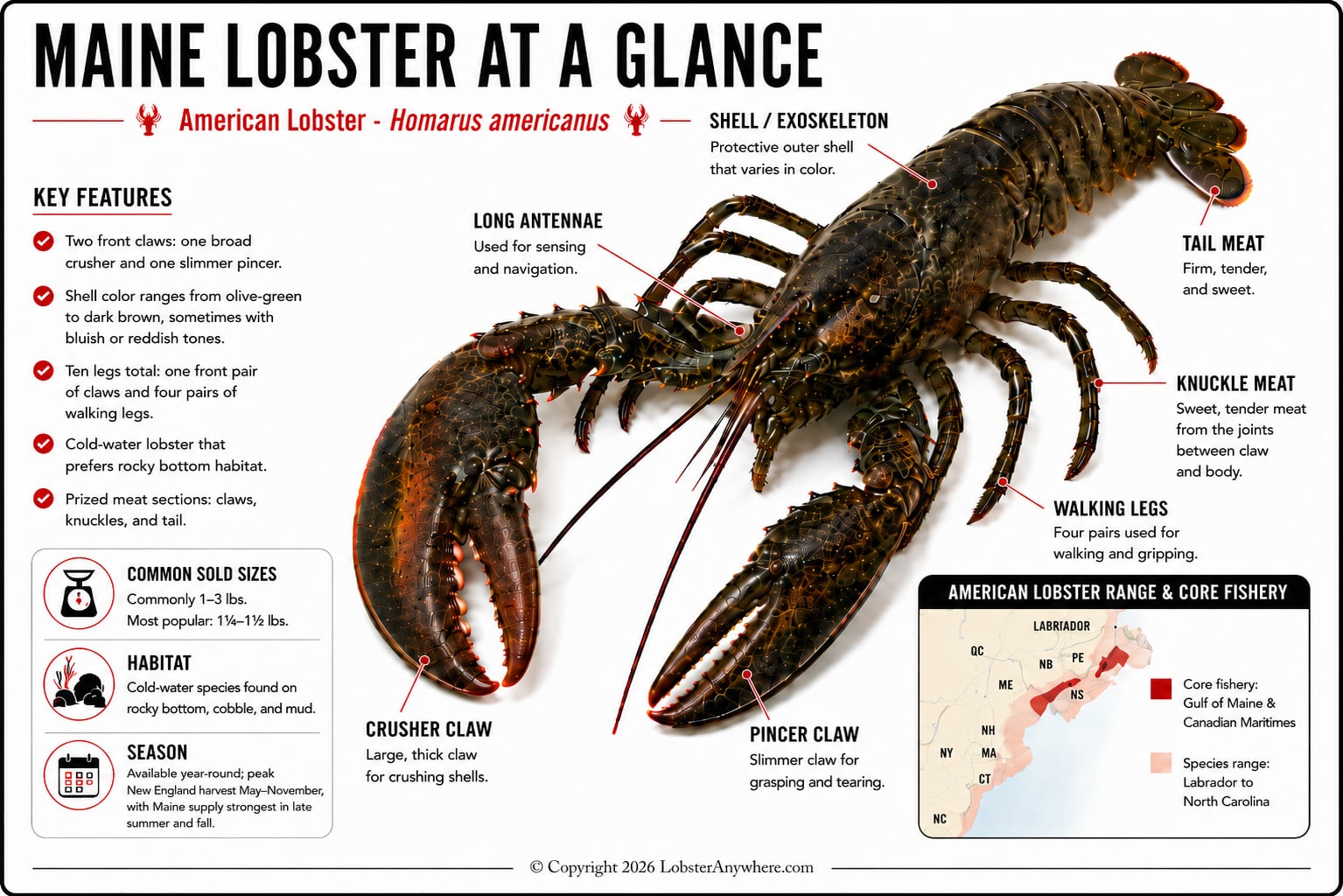
First, you have to select the right species of lobster: Homarus americanus, also known as the American Lobster, Boston Lobster, New England Lobster, Atlantic Lobster, Northern Lobster, Nova Scotia lobster, and, of course, the Maine Lobster. This large crustacean has a long body and five sets of legs, with one pair featuring big, strong claws. In fact, almost half of the lobster’s weight comes from its claws. Its shell can be mottled brown, green, and black. In cold waters, like those of the northern Atlantic, lobsters grow at a slower rate. This is why Maine lobster meat is firmer and more succulent. The cool temperatures keep the salt water from permeating the meat.
What’s the Difference between a Maine Lobster and a Spiny Lobster?
The Maine lobster should never be confused with the spiny lobster, Panulirus arus, or rock lobster. Maine lobster is easily distinguished from the “spiny” lobster by its large, heavy claws. The spiny lobster is caught in warm waters off Florida, in the Caribbean, and on the southern California coast. The spiny lobster features long, strong antennae and a pair of horns above the eyes, but with no big front claws. The spiny lobster has tiny claws and is usually marketed as uncooked frozen tails. It is often processed as cheap tails and sold at the big club stores. Because of its sweet, delicious flavor and tender texture, Maine lobster is the world’s most prized catch.
Lobster Season
Lobsters are trapped throughout the year. Typically, some of the best months to buy hard-shell lobsters are in late spring, from May to June, and again in the fall, from October to November. New shell lobsters are usually harvested from late summer to early fall.
Live Maine lobster is available year-round, with the bulk of the catch harvested in the summer and fall. In the winter months, many lobstermen pull their traps to avoid damage and danger of Nor’easters and other storms. The price of lobster, like most prices, is ruled by supply and demand, as well as the weather. Unpredictable weather and seasonal changes affect supply. In recent years, the lobster seasons have been anything but typical.
Lobster prices usually rise at the start of Memorial Day and drop as the season ends with Labor Day weekend. May and September are good times to buy hard-shell lobsters. In June and July, when lobster molting is at its peak, the majority of lobsters sold locally are soft-shell.
Hard Shell Lobsters
Lobsters grow by molting, or shedding their shells. Just after they molt, they are soft and fragile until their new shell has hardened. (It takes about 25 molts over 5-7 years for a lobster to grow to a minimum legal size, 1 pound.) Newly molted lobsters are called soft-shell or “new shell” lobsters. It is important to be aware of the quality and price of soft-shell lobsters. Soft-Shell lobsters have less meat in proportion to total body weight than hard-shell lobsters. Hard-shell meat is firmer, while soft-shell meat is softer and tends to have more water. Because soft-shell lobsters are not as strong as hard-shells, they do not ship well. This is why soft-shell lobster is always less expensive. Cracking a hard-shell Maine lobster takes some effort, but the results are more than worth it. Learn more about how to buy hard-shell lobsters.
Lobster Fishing

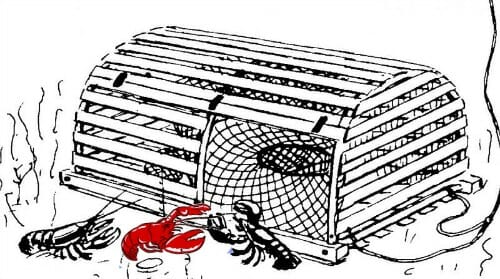
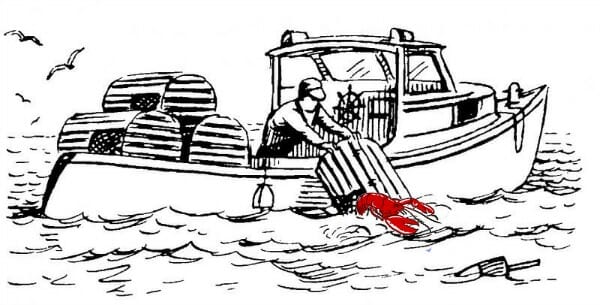
Lobsters are caught in traps, marked with colorful buoys to identify their owners. If you happen to be out on a boat and come across one, don’t even think about pulling it up to take a look. There is no real authority specifically governing lobster traps, unless you count Smith & Wesson, and the notoriously short-tempered lobstermen themselves.
When the lobsters are taken from the trap, they are “banded” with strong rubber bands. Sometimes you might see wooden plugs inserted into the base of the claw. Do not remove the bands or plugs…they are there for your safety!!!
The State of Maine has very strict laws governing lobstering. Lobster traps may not be hauled at night and on Sundays during June through August in Maine waters (since 1967). In Maine, it is illegal to keep lobsters under or over a certain size. Lobstermen use a special gauge to accurately measure the length of the lobster’s carapace (body)–from the eye socket to the beginning of the tail to ensure legal compliance.
Legal Minimum and Maximum Size Lobster
The legal minimum length is 3 1/4 inches. Lobsters under this length are called “shorts” or “snappers” and must be thrown back into the ocean. Minimum sizes are enforced to make sure that lobsters are mature enough to breed at least once before they are harvested. When a female egg-bearing lobster is found, it is required by Maine law that a V-shaped notch be placed in the right tail flipper before releasing the lobster, in order to protect her so that she may continue to reproduce.
The maximum legal length of a lobster is 5 inches carapace length, which is called “jumbos”. The maximum size limit is regulated to protect the breeding stock. A minimum size lobster will weigh around 1 pound, while a maximum size lobster will weigh between 3 and 4 pounds. The most plentiful and most popular size of Maine Lobster is between 1 1/4 and 1 1/2 pounds each.
Lobster Color
Contrary to popular belief, live lobsters are not red in color, but are actually a dark blue-green color because of the many different color pigments. When cooked, all the pigments except the red one (astaxanthin) are hidden. Besides the typical colored lobsters, there are also rare yellow, red, blue, and white specimens. About 1 in every 30 million lobsters is born with a blue shell. Lobsters are usually active at night and eat fish, crabs, clams, mussels, sea urchins, and sometimes other lobsters!
You can tell if a lobster is a male or a female by looking at their first pair of swimmerets, found on the underbody of the lobster. The swimmerets on the male are larger and bony; they are smaller and softer in the female.
Lobster Nutrition
Maine lobster is not only great tasting, but it’s also healthy – that is, if you go easy on the butter. It’s hard to believe, but Maine Lobster has less cholesterol, calories, and saturated fats than lean beef, skinless chicken, and pork. Lobster is a good source of protein and omega-3 fatty acids, which have been shown to reduce arterial hardening and the risk of heart disease. Lobster is also high in amino acids, potassium, magnesium, calcium, phosphorus, zinc, iron, vitamin A, and many of the B vitamins. Read more about lobster health facts.
Lobster Cooking
Live lobster can be boiled, steamed, grilled, or baked. The white meat of the Maine lobster is located in the tail, claws, and knuckles. Meat can also be found in parts of the body, including the legs. The red material in the tail section is the coral “roe,” or the female eggs, and is considered a delicacy. The greenish material at the junction of the body and tail is “tomalley”, which is actually the liver, and has a very unique “peppery” taste used in many recipes.
Don’t worry about cooking live lobsters. Lobsters have a ganglionic nervous system (as opposed to a central nervous system), so they do not feel “pain” the same way that we do. The supposed “screaming” in the pot is actually the sound of steam escaping from the lobster’s shell.
Cooking a lobster longer than the recommended time usually makes the meat too tough. When properly cooked, lobster meat is creamy white, the shells are bright red, and the two front antennae pull out easily. A 1-2 pound whole lobster serves one person. A pound of meat can be removed from four to six lobsters weighing 1.25 pounds (typical market size). Approximately two cups of lobster meat equals one pound.
For more Maine lobster cooking instructions, be sure to visit our cooking and handling guide for the best times
Though Maine lobster is best enjoyed “in the rough” (cooked whole in the shell), it lends itself to a variety of recipes and styles. Celebrate, anytime of year, anywhere in the country, with the finest live Maine Lobster from LobsterAnywhere.com.
Product Froms
Maine lobster is available in many product forms, including live, whole, frozen, frozen tails, claws, meat, and other specialty or value-added products.
Lobster Serving Suggestions
Lobster linguine, lobster pate, lobster stew, lobster bisque, lobster salad, steamed lobster, baked lobster, grilled lobster, stir-fried lobster. Fortunately, Maine lobster is not only delicious but also easy to prepare. Anytime of year, celebrate with Maine lobster!
[wd_hustle id=”11″ type=”embedded”/]
Glossary of Lobster Terms
- Banded: A strong elastic is placed around the claws of the live lobster for safe handling and to preserve quality.
- Berried Lobster: a female with eggs under her tail, which appear like a cluster of berries. Under Maine and Canadian law, these must be returned to the sea.
- Blues: a lobster, which is blue is color, a rare occurence. Lobsters can have a mottled appearance (or uneven color, varying in shades) or, rarely, a white or yellow lobster. This is a pigmentation only, and does not affect the flavor or texture. All lobsters turn red when cooked.
- Brine: salt water used to cook or to store frozen tails, meat, or whole cooked lobster.
- Canners: a small lobster, weighing about 1/2 to 1 lb. (175 to 450g), not sold from Lobsteranywhere.
- Carapace: the large main body shell covering the front part of the lobster. The body shell is measured from the back of the eye sockets to the end of the body shell (not tail) to determine legal size.
- Chix (Chickens): lobsters weighing about 1 lb. (450 g), not sold by Lobsteranywhere.
- Coral: internal roe or eggs of the female lobster.
- Crusher: the larger of the two claws of the Maine lobster.
- Cull: A lobster with one claw is normally sold at a discount.
- Dorsal: The top surface of the lobster.
- Escape Vent: Opening in a lobster trap that allows undersized lobsters to escape.
- Flipper: a large flattened piece, together with others, forming the tail fin.
- Gastric Mill: the grinding located inside the lobster’s stomach.
- Gauge: the legal measure used to check the minimum and maximum size of a lobster to make sure it is the proper size to keep.
- Ghost Panel: a section designed to open the trap that is lost while fishing, thus releasing lobsters.
- Ghost trap: a trap that no longer has a line attached to a buoy on the surface of the water.
- Hard Shell: a lobster with a firm shell and full of meat.
- Head: the opening by which a lobster enters a trap.
- Halves: lobster weighing 1.5 to 1.74 lbs. (681 to 790 g).
- Hard Shell: a lobster whose shell has fully hardened after molting. Hard-sheled lobsters yield 50 to 60% more meat than soft-shell or shedders.
- Hog Ring: a small metal ring that holds the plastic escape vent in place.
- Jumbos: whole lobster weighing more than 3 lbs. (1.4 kg).
- Markets: a size category for lobsters weighing 1 to 3 lbs. (450 g to 1.5 k grams).
- Molting: the process of shedding the shell to grow in size.
- Parlor: The part of the lobster trap designed to hold lobsters until they are removed by the lobstermen.
- Pincher Claw: the small claw of the lobster used primarily for tearing or ripping.
- Popsicle Pack: term used to describe a whole cooked lobster, packed in brine and frozen.
- Pound: a storage area for holding live lobsters.
- Quarters: lobster weighing 1.25 to less than 1.5 lbs. (568 to 676 g).
- Rostrum: sharp bony projection or “horn” located above the lobster’s eye sockets.
- Runner: A devise on the bottom of a lobster trap that prevents damage to the lobster claws and allows the trap to be pulled smoothly out of the water.
- Scrub: The artificial removal of a female lobster’s eggs.
- Seasons: specific periods in the year in Canada when a particular area or region can be fished.
- Selects: lobster weighing 2 to 2.49 lbs. (908 to 1,130 g).
- Shedders: lobster in the molt or soft-shell stage of growth with a small quantity of meat.
- Smack: Small sailing vessels with a tank inside that had holes drilled into it to allow seawater to circulate. Smacks were developed in the 1800’s to transport live lobsters over long distances.
- Soft Shell: a lobster after it molts or sheds its hard shell. The new shell remains soft for a period of time to facilitate growth. During this soft-shell, the meat yield is low, and the meat texture is soft and watery.
- Stem: the main upright timber or metal piece at the bow of a boat, to which the boat’s sides are joined.
- Swimmerets: flap-like structures located underneath the lobster’s tail, with the first pair distinguishing a male from a female.
- Trap or lobster pot: a cage-like structure set on the ocean bottom used to catch lobsters alive.
- Tomalley: green colored liver of a lobster. This digestive gland absorbs food and toxins.
- V-Notch: a distinct V-notch of any size in the end part of the flipper to the right of the middle.
- Ventral: The underneath side of a lobster.
- Walking Legs: the long, thin legs used by the lobster to walk.
Lobster Fun FAQs
We’ve been working with Maine lobsters for close to twenty years and have come across plenty of questions from landlubbers and lobster aficionados alike. Find answers to frequently asked questions, plus learn interesting lobster trivia. We hope these fun facts heighten your appreciation for the crustaceans.

For the most part there are two main types of lobster, cold water and warm water. Cold water lobster is commonly caught off the coast of New Zealand, south Africa, Australia, and of course Maine. These lobsters are firmer sweeter and more succulent, with whiter meat.
Homarus americanus, also known as the American Lobster, Boston Lobster, New England Lobster, Atlantic Lobster, Northern Lobster, Nova Scotia lobster, and of course the Maine Lobster. This large crustacean has a long body and five sets of legs, and one pair that features big, strong claws. In fact, almost half of the lobster’s weight comes from its claws. Its shell can be mottled brown, green and black.
The Maine lobster should never be confused with the spiny lobster, Panulirus arus or rock lobster. Maine lobster is easily distinguished from the “spiny” lobster by its large heavy claws.
Lobsters curl and uncurl their bodies to move backward quickly.
To get away in a hurry, the lobster swims backwards by vigorously flipping its tail and can escape quickly by swimming this way. They also use their swimmerettes and walking legs to move through the water.
Small lobsters (less than 1-1/2 ” carapace length) live in and around the coastal sea weeds and rocky habitat where there they can hide from prey. Bigger adolescent lobsters (1-1/2″ to 3-1/2″ carapace length live in coastal and offshore areas. Larger lobsters will migrate to deeper offer shore areas and may migrate seasonally to shallow warmer waters.
It was once thought that lobsters were scavengers and ate primarily dead things. But new research has shown that lobster catch fresh food (except bait) which includes fish, crabs, clams, mussels, worms, sea urchins, slow-witted flounders and sometimes other lobsters! Occasionally they eat plants. Lobster are nocturnal and will usually hunt for food at night.
Lobster Thermidor is said to be named by Napoleon.Thermidor was the 11th month of the calendar used during the French Revolution.This classic French dish is made with egg yolks, brandy and the lobster’s meat stuffed back into its shell for serving. Here’s a recipe for easy Lobster Thermidor
Lobster fishing is most active in the Gulf of Maine, Bay of Fundy, Southern Gulf of St. Lawrence and coastal Nova Scotia.
Maine’s iconic license plate featuring a bright red lobster was designed by elementary school children in 1987.
According to the Guinness Book of World Records, the largest lobster ever caught was a 44-pound leviathan caught in 1977 off the coast of Nova Scotia.
Looking for a really big lobster online? Check out our colossal lobsters.
It’s a female lobster carrying eggs under its tail. In Maine it is illegal to keep egg bearing lobsters. Lobstermen will put a v-notch in the tail flipper of egg bearing female lobster and return them to the sea. This practice dates back to the 1900’s and preserves the the future health of Maine’s lobster fishery.
A chicken lobster is a small lobster that weighs about one pound. LobsterAnywhere does not sell chicken lobsters. Would you want a tiny lobster or a good sized lobster shipped to you?
You guessed it. A male lobster is called a cock.
It’s a lobster with only one claw. Most culls are processed for their meat, but you can buy them at lobster pounds at a good price if available.
A lobster may live 100 years, grow to 5 feet, and weigh as much as 45 pounds! Officially, the largest lobster ever caught weighed 44 pounds. A lobster’s age is approximately his weight multiplied by 4, plus 3 years. A lobster is approximately 7 years old before it is legal to harvest, and it will weigh about 1 pound. A lobster has a greater life expectancy than most humans. A 25 pound lobster could be over 100 years old!
Two kinds of lobster-like crustaceans exist in the United States waters. The “true” lobster (the Maine lobster) is designated as such to differentiate it from the other from, the “spiny” lobster. The Spiny Lobster of southern waters and of the Pacific is not a close relative. The two, from different families, display two major differences. The New England lobster has claws on the first four legs, lacking in the spiny lobster. The spiny lobster has a pair of horns above the eyes, lacking in the true lobster. LobsterAnywhere only ships cold-water Maine lobsters, the tastier of the two.
You don’t want to buy a sleeper lobster. You may have spotted one floating in your local grocery store lobster tank. A sleeper lobster is a sluggish or not so lively lobster that may be near death. Learn more about how to select a lively lobster.
Soft-shell is the term used for a newly molted lobster. Learn More about Hard-Shell Lobsters.
A hard-shell lobster is one whose shell has fully hardened after molting. Hard shells as the name implies, are hard to crack. Hard-shell lobsters yield 50% more meat than soft shell lobsters. Learn More: Hard-Shell Games: Hard Shell vs. Soft Shell Lobster
Yes, they regrow claws, legs, and antennae.
Female lobsters do not have their eggs fertilized right away after mating. They can choose the perfect conditions for having their babies which may be a year after they’ve mated with a male.
The crustacean is packed with protein. There is a whopping 28 grams per serving and as few as 96 calories if not dipped in butter. Learn more about the nutritional benefits of Maine lobster.
Sorry Phoebe from Friends, lobsters are rather promiscuous, and actually mate with multiple partners. A dominant male lobster mates with multiple female partners.
It was appropriately called “Pinchers” the lobster.
It can take a female lobster about 10 years to reach sexual maturity!
No you must be a resident of Maine and have the proper license. Did you know the wait list for a Maine lobster license can be more than a decade long! Find out more about the laws of lobstering.
No. Lobsters may be caught all year long. There are some months of the year that the catch is at its peak. Learn more about Maine lobster seasons.
Typically some of the best months to buy hard-shell lobsters are in late spring, from May to June and again in the fall, from October to November. New shell lobsters are usually harvested from late summer to early fall.
On July 5, 2017 the world’s longest lobster roll was constructed in Shediac, Canada and measured 180 feet long! It took 125 lb. of lobster meat at a value of $5000.
The Burnham & Morrill Company opened a lobster cannery in 1836. This Portland, ME company is now better known as B&M, now famous for its baked beans.
Lobsters are tagged by researchers to evaluate migration patterns and other characteristics. According to this research one lobster holds the record for traveling 225 miles. This particular lobster was tagged off the Continental Shelf and recovered at Port Jefferson, Long Island, New York! Also, there was a Lobster that traveled from Maine to Nantucket (273 miles) but some argue those results.
The American lobster, Homarus americanus has been commercially fished for 150 years.
There are about 4500 lobstermen harvesting lobster in Maine.
In the state of Maine 800 is maximum number of traps each lobsterman may set.
Although they are sometimes called “cockroaches of the sea”, they are not in the class Insecta and are not insects. Lobsters have two body segments, while an insect has three. The lobster also has eight legs, while insects have six. Lobsters like other crustaceans are arthropods and belong to the subphylum Crustacea. Meaning they have a segmented body, jointed legs and an exoskeleton which they molt at intervals.
They deliberately dehydrate themselves as they get closer to molting time! They get smaller, slip out of the old shell, then they eat the old shell for all those minerals and harden up a new bigger shell.
A one pound female usually carries around 8000 eggs! Thats 9 to 12 months inside her body and another 9 to 12 outside before they hatch and float to the surface of the ocean. Sadly only 0.1% of those prelarvae survive longer than six weeks after hatching.
Here at LobsterAnywhere , we sell the American Lobster, aka Homarus americanus, a species of lobster found on the Atlantic coast of North America. These cold water lobsters are straight off the Maine coast, only have two large claws and whiter meat than warm water lobsters, and are what people think of when they refer to Maine lobster.
The Maine lobster is available as hard shell lobsters, which is what we ship live. Soft shell lobsters, or shedder lobsters, which are sweeter but contain less meat, cannot survive long-distance shipping, so are generally eaten only close to where they are caught.
Lobsters are truly remarkable (and delicious) creatures! It’s hard to believe there was ever a time when they were used as fertilizer for crops. In fact, we’re glad they aren’t, because it leaves more for us to sell and for you to eat.
What percentage of a lobster’s weight does it eat per day?
Why are most of the lobster pounds closed on Wednesdays?
How old does a lobster have to be to produce a 22oz tail?
It's tough to tell the age of a lobster, but the tail from a 20 oz. plus lobster is a big one. The tail is likely from a 7-10 pound lobster. And just guessing, it could be 40 years or older. New research from the University of New Brunswick claims to better predict the age of lobsters by counting the annual growth bands or rings in lobster's eye stalks and gastric mill. See more on how to calculate the age of lobsters.